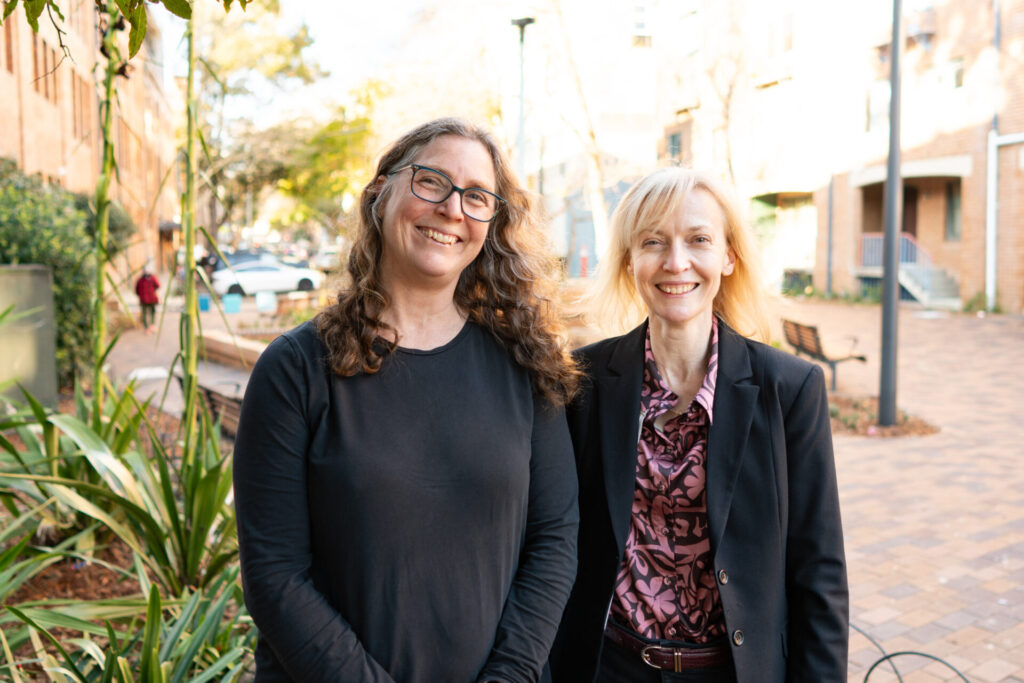
Professor Angela Moles is an ecologist at UNSW’s School of Biological, Earth and Environmental Sciences. Her research focuses on how Australian plants and ecosystems are responding to climate change and to introduced species, and she chairs the NSW Threatened Species Scientific Committee. She also plays a national leadership role in ecology teaching through the Ecological Society of Australia.
What first drew you into your field of STEM, and was there a particular person, teacher or moment that helped set you on that path?
I heard the Chinese premier Li Qiang speak recently, and he said “there is no path, the path is made by walking”. This is definitely the case for my career.
I had an amazing high school biology teacher – Rose Hipkins, who is the mother of recent New Zealand prime minister, Chris Hipkins. I also spent lots of my childhood happily roaming around in New Zealand forests. However, I didn’t know what I wanted to do when I started university, and didn’t know that “plant ecologist” was a thing you could be. I just did a range of interesting first year science courses and figured out as I went along what I liked most. A couple of inspiring plant ecology lecturers at university, and before I knew it, I was a world expert in seed ecology – and yet still somehow managed to get an awesome job.
What does STEM look like in your current work, and how is it different from what people might imagine?
You might think of science as being a bit solitary – but actually most of the cutting-edge research solving the world’s big problems involves big interdisciplinary teams, usually including people from all around the world who have different skills and perspectives. These big collaborations are fun to work on as you learn all sorts of new things.
You might also think of scientists doing a lot of data collection in the lab or in the field. However, I spend most of my working life on written and spoken communication (writing scientific papers and emails, helping my students to learn to write well, and in meetings, presentations, and teaching).
You might also be surprised by how many different things we end up doing as scientists working at a university. We do spend a lot of our time doing research in our chosen field and teaching undergraduate and postgraduate science students, but we also get to choose ways to have impact on society. For example, I chair the NSW Threatened Species Scientific Committee, which is the organisation that gets to decide that a plant or animal species qualifies as endangered. Scientists also get to do all sorts of science communication things. In the last year, I got to go to the Geneva Science Diplomacy Anticipator session to give a talk to tell politicians and diplomats from all around the world about where I think ecology is headed in the next 25 years (lots of change in response to climate change). I was also on a panel with two billionaires on the topic of “Nature is Infrastructure” at the World Economic Forum, and I got to present in a television series on the future of life on earth. I also spent some time developing a resource to help university academics understand how they can best help their neurodiverse students, and another resource to help neurodiverse students to navigate a degree in ecology, wrote a paper about an idea for fixing the peer-review system, rewrote the course materials for a class that has 1100 students, and spent 10 days exploring Brazilian ecosystems. As long as we are being productive, our bosses don’t really mind what exactly we are doing, and that is really fun – it never ever gets boring.
What is a piece of work, discovery or achievement from your career that you are most proud of, and why does it still matter to you?
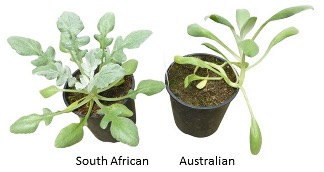
I am most proud of my work on rapid evolution in introduced species. My students and I studied the beach daisy (Arctotheca populifolia), which was introduced to Australia from South Africa in the 1920s. We used genetics to determine exactly which beach in South Africa the Australian populations came from. We collected seeds from the source population and from Australian populations, and grew them through several generations in the UNSW glasshouse. We found striking differences in the ways native and introduced populations grow, photosynthesise and reproduce (see image). There is now a 6-week difference in flowering time between Australian and South African populations (so they can’t swap pollen even if they grow side by side), and seeds from crosses between South African and Australian plants have ~30% lower viability than do seeds with parents from the same country. This suggests that the introduced population is becoming a new, reproductively isolated species that only occurs in Australia. This work is important, as it shows just how fast species can change when they are introduced to an area with different environmental conditions. That is, the fact that these introduced plants can change so quickly gives me hope for how our native plants will be able to respond to climate change. I also quite like how much the concept of an introduced plant becoming a new native species hurts people’s heads when they first hear it!
As someone working in STEM, what do you think a holistic education gives a young person that a narrowly academic education might miss?
I feel that focusing all your energy on developing the technical skills you need for a particular job is a bit short sighted. The world is changing very very rapidly, and I don’t think any of us are able to guess what type of jobs current IGS students will be doing by the time they retire. However, there are some enduring skills – the most important of which are curiosity, creativity, adaptability, and being able to work well with others. I think a holistic education is the best way to develop these qualities – and to become a well-rounded person who is fun to hang out with.
Mathematics and coding are often described as languages for understanding patterns, solving problems and creating new possibilities. How do you see these languages connecting with science, technology, creativity and communication?
Many things in science (e.g. the world’s ecosystems, ocean currents, people’s brains and even economies) are wildly complicated, and are affected by potentially thousands of interacting variables (for example, a plant species’ distribution might be affected by climate, light, soil, interactions with many different types of pollinators, seed dispersers, seed predators, herbivores, soil microbes and other plants). Our intuitions about how complex systems work can only take us so far (and are often wrong). The languages of maths and coding give us the tools to be able to understand the trade-offs that shape the complex systems of the world, and to make sense of multivariate datasets and test hypotheses. Being without maths and coding is as unthinkable in modern science as being without a language for communication.
Being able to communicate clearly is an absolutely foundational skill for all scientists. No matter how beautiful an idea is, it can only have impact if the scientists are able to communicate the concepts to a wide range of people, and to help those people to understand why the idea is important to them.
It is an interesting time in the field of coding at the moment – it is possible that AI is already better at coding than people. This is giving scientists a whole new set of tools with which to understand the world – and our use of these tools is really only limited by our own creativity.
What advice would you give to IGS students who are curious about STEM but are still working out where their interests might lead?
I think there is way too much pressure in our current system to have your entire career planned out by the time you are 16. Relatively few people actually do what they thought they would. Just start out in a direction that appeals to you, learn as much as you can along the way, keep an open mind, make friends, make the most of opportunities, and see where you end up! It’s also worth asking people with jobs you think are interesting what their formal training was. You will be amazed at the rage of directions a qualification can take you in.